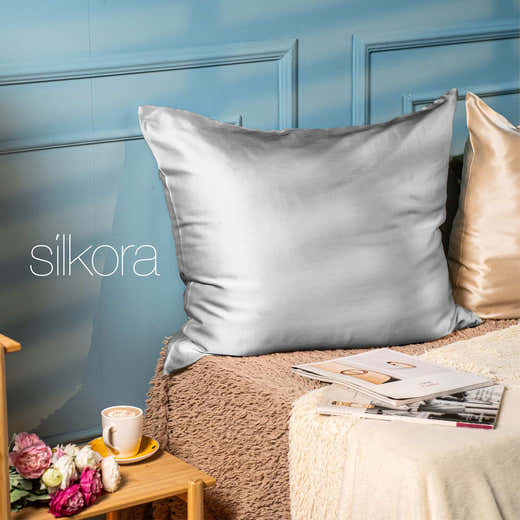
Satin pillowcase or silk pillowcase: which is better?
In the shop they look almost identical: both smooth, both shiny. Yet a silk pillowcase costs several times as much as a satin one. What do you get for the difference, and when is satin perfectly fine? Silkora sells only silk, so we'll be upfront: satin has its strong points too. Below we compare the two on fibre, smoothness, warmth, washing and price, and explain how to recognise real silk.
Fibre and weave: where the difference lies
In a satin weave, the threads on the surface float over several threads at a time instead of going over and under one by one. That creates an even surface that reflects the light. The weave works with all kinds of yarn: polyester, viscose, cotton or silk. If the label only says 'satin', it is in practice almost always polyester, a plastic made from crude oil. Cotton sateen, common in bed linen, is the same weave in cotton: it shines more than ordinary cotton, but because cotton fibres are short it is never as smooth as silk or polyester satin.
Silk pillowcases are usually woven in a satin weave as well. That fabric is called silk satin or charmeuse, and Silkora's pillowcases are woven this way: charmeuse made of mulberry silk. So the difference from a satin pillowcase isn't the weave but the yarn: protein from the silkworm's cocoon versus plastic from a factory. That explains nearly every other difference, from warmth to price.
- Satin = the weave
- Silk = the fibre
- Charmeuse = silk in a satin weave
- Cotton sateen = cotton in a satin weave

Silk and polyester satin side by side
Three of these points decide most choices:
Momme: a measure for silk
Momme is the unit used for the weight of silk. A higher number means a fuller, denser fabric. The measure isn't used for polyester satin. If you do come across a satin pillowcase with a momme figure, check that the label also says '100% silk'. Silkora uses 22 momme mulberry silk of Grade 6A. How many momme you need is explained in our buying guide.
Smoothness: little difference for your hair
Tangles and frizz come mainly from friction, and there silk and satin are close: both are much smoother than cotton. If fewer tangles in the morning is what you're after, a good satin pillowcase already does a lot. What a silk pillowcase does and doesn't do beyond that is in our article on silk, skin and hair.
Breathing and warmth: silk wins here
Polyester lets little air and moisture through. On a warm night a satin pillowcase can start to feel clammy, right where your cheek rests. Silk lets more air through and feels fresh the moment you put your head down. The two also handle moisture differently: polyester absorbs almost none, silk a little and cotton a lot. So silk feels clammy less quickly, while less of your night cream soaks into the fabric than with cotton.
In dry air, for example in winter with the heating on, polyester can also become static. Fine hairs then float or cling to the pillowcase.
Washing: satin wins here
A polyester satin pillowcase is easy to look after. It can often go in at 40 degrees, sometimes in the tumble dryer, and it hardly creases. Do check the label, as it varies from one pillowcase to the next. Silk needs more attention: a laundry bag, a silk detergent, 30 °C at most and no tumble dryer. How to do that in a few minutes each week is in our step-by-step guide to washing a silk pillowcase.
Price: why silk costs more
Polyester is made in large quantities in factories, and you see that in the price: a satin pillowcase often costs a fraction of a silk one. Silk has to be farmed. The caterpillars eat mulberry leaves for weeks, then the cocoons are unwound and the thread is woven into fabric. A dense 22 momme fabric takes a lot of silk. That is why a Silkora silk pillowcase starts at €49.95. Whether it's worth it depends on what matters to you.
How to recognise real silk
A pillowcase that shines and feels smooth isn't necessarily silk. Here's what to look for:
Note: an OEKO-TEX® label says something about harmful substances, not about the material. A polyester pillowcase can carry that label too.
Where satin does better
- Price: for the price of one silk pillowcase you can buy several satin ones.
- Care: warmer washes, often the tumble dryer, and hardly any ironing.
- No animal fibre: silk comes from the silkworm. If you'd rather not use animal products, polyester or viscose satin suits you better.
- Frequent washing: for a guest bed or a child's room, where a pillowcase often goes in the wash without fuss.
Which suits you?
Still weighing up cotton, bamboo or flannel? Our comparison of pillowcase materials covers them all.